My research focuses on cold neutral (molecular/atomic) interstellar medium in nearby galaxies. I’m investigating the interplay between the content of neutral atomic gas, (dense) molecular gas, and star formation, and how this gas contributes to the formation of stars. I like to analyse the structure, chemistry, and kinematics of galaxies. For this, I work with observational data, especially in the radio/mm-cm domain, using e.g. VLA, ALMA, MeerKAT, SMA, IRAM-30m, PdBI/NOEMA, or multi-wavelength observations.
I’m leading observational efforts in the PHANGS and MHONGOOSE collaborations, and recently collaborated with LGLBS, GOALS-east (a sub-group of the GOALS), and Starburst Heaters (a sub-group of ALCHEMI).
Below is an overview of my research areas with associated papers.
Physical drivers of the molecular gas fraction in nearby galaxies
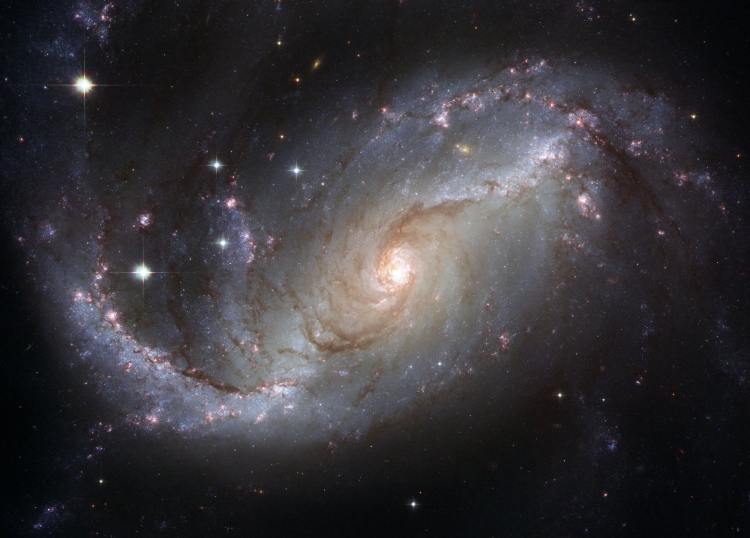
I’m very interested in studying the molecular gas fraction (Rmol) ever since it’s a crucial metric for understanding how galaxies convert atomic gas into the dense molecular clouds that fuel star formation. By examining how Rmol responds to variations in pressure, metallicity, and star formation rate, me and my collaborators gain insight into the physical conditions that govern cloud formation and regulate star formation efficiency. Studying Rmol across diverse galactic environments also reveals how factors like tidal interactions and AGN feedback impact the molecular gas reservoir, shedding light on key processes in the star formation cycle.
Papers:
Eibensteiner+PHANGS, 2024
Eibensteiner+LGLBS collaboration, collaboration review
+ my 2 new ALMA cycle 11 observations
& my VLA Large Program
HI and Kinematics of nearby galaxies
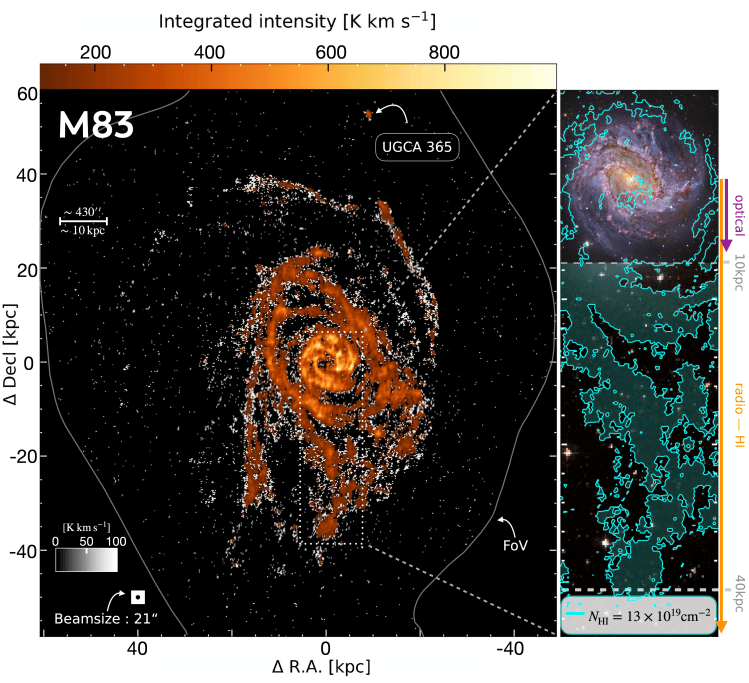
I really think maps of HI disks are one of the most impressive things I have seen regarding nearby galaxies, as they extend way beyond a galaxie’s optical radius! Studying HI and the kinematics of HI disks is essential for understanding how galaxies evolve and regulate star formation over cosmic time. The distribution and velocity structure of atomic gas provide critical insights into gas accretion, feedback processes, and the buildup of molecular gas reservoirs. By examining and modeling the HI disks, we can trace the flow of gas throughout the disk and assess how these processes shape star formation
and galactic structure.
Papers:
Laudage, Eibensteiner+PHANGS-HI, 2024,
Eibensteiner+PHANGS-HI, 2023,
Pingel (incl. Eibensteiner LGLBS), 2025,
Koch (incl. Eibensteiner LGLBS), 2025
+ my VLA Large Program & co-I of MeerKAT XLP
The molecular ISM in extragalactic central molecular zones (eCMZs)
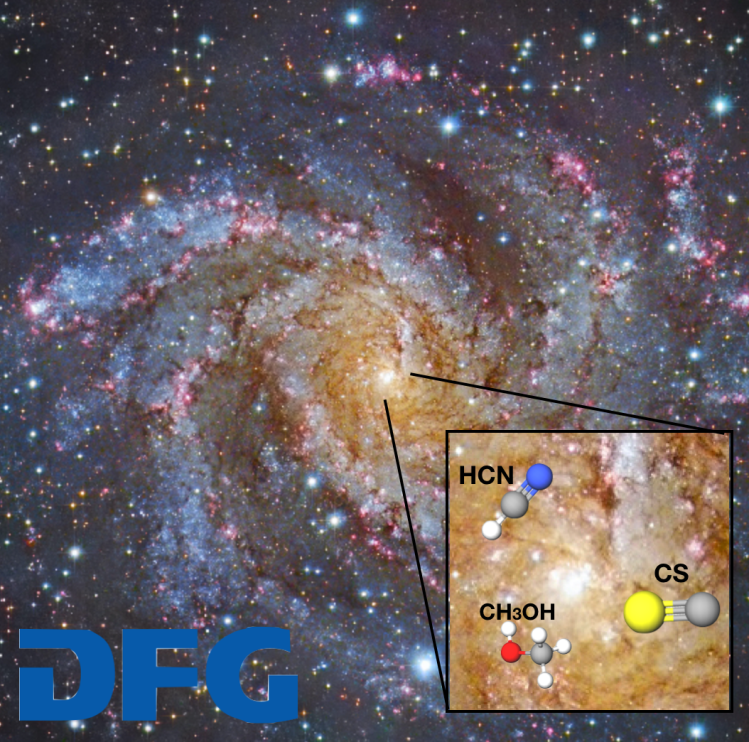
I also like very extreme environments! eCMZs offer a unique window into the most extreme environments of galaxy centers, where gas densities, pressures, and star formation rates are elevated. Studying these regions reveals how molecular clouds form, evolve, and collapse under intense tidal forces and strong gravitational potentials, providing critical insights into the star formation cycle under extreme conditions. By comparing eCMZs across different galaxies, we can also assess how central activity, such as AGN feedback or bar-driven inflows, regulates molecular gas properties and triggers starbursts.
Papers:
Eibensteiner+2022,
Teng (incl. Eibensteiner), 2023+24
+ my NOEMA, SMA, and VLA observations
The impact of AGN and Bars on molecular ISM
in Galaxies
Understanding the impact of AGN and bars on the molecular ISM in galaxies is for me important to unraveling how galactic dynamics and central activity regulate star formation and gas distribution. AGN-driven feedback can heat, compress, or expel molecular gas, altering star formation efficiency and reshaping the ISM structure. Similarly, bars can funnel gas toward the nucleus, triggering starbursts or fueling AGN activity, while simultaneously influencing gas dynamics and molecular cloud properties throughout the disk. By studying these processes, we gain critical insights into how central activity shapes the evolution of molecular gas reservoirs and the broader star formation cycle
Papers:
Sánchez-García (incl. Eibensteiner, GOALS), 2025
Johnstone (incl. Eibensteiner, GOALS ), 2025
Eibensteiner+2022 (second part of that paper including EMPIRE galaxies );
Sormani (incl. Eibensteiner, PHANGS), 2023
ISM across Nearby Galaxies
PHANGS pionieered studing the distribution of CO at high resolution across entire galaxies! By studying the interstellar medium (ISM) via CO (+isotopologues) and HCN across we can probe the physical conditions and chemical compositions of molecular gas under diverse environments. CO isotopologues trace different density and temperature regimes, providing insights into gas opacity and cloud structure, while HCN serves as a powerful tracer of dense star-forming regions. By comparing these molecular lines across galaxies, we can assess how metallicity, star formation activity, and AGN feedback influence molecular gas properties, enabling a more comprehensive understanding of the star formation cycle and the evolutionary pathways of galaxies.
Papers:
Zhang (incl. Eibensteiner), 2025,
Neumann (incl. Eibensteiner), 2023+24+25
Teng (incl. Eibensteiner), 2023+24
den Brok (incl. Eibensteiner), 2022+23,
García-Rodríguez (incl. Eibensteiner),
Leroy (incl. Eibensteiner) , 2021+22
Bešlić (incl. Eibensteiner) , 2021+24
Star Formation in Nearby Galaxies
Studying star formation laws in nearby galaxies enables us to calibrate key scaling relations, such as the Kennicutt-Schmidt law, linking gas surface density to star formation rate surface density. Additinally, by analyzing continuum SEDs, we can disentangle thermal and non-thermal components, providing more accurate measurements of star formation rates and tracing how gas content and star formation efficiency vary across different galactic environments. These local calibrations are essential for interpreting unresolved observations at high redshift, where star formation tracers are blended and subject to greater uncertainties.
Papers:
Dignan, Murphy, Manson, Eibensteiner + SFRS, 2025
Saravia (incl. Eibensteiner), 2025
Schinnerer (incl. Eibensteiner), 2023
Belfiore (incl. Eibensteiner), 2023
Pan (incl. Eibensteiner), 2022
Querejeta (incl. Eibensteiner), 2021
Chemistry in Nearby Galaxies
I enjoy learing more about more complexe extragalactic molecules! Studying molecular chemistry in nearby galaxies provides critical insights into the physical and chemical conditions that regulate star formation and feedback processes. However, extragalactic detailed chemical inventories are currently feasible only in galaxy centers, where molecular gas is abundant and bright enough to detect complex faint species, including interstellar complex organic molecules (iCOMs). These regions are also subjected to elevated cosmic ray fluxes, which can drive ionization and chemical reactions, influencing the abundance and distribution of key molecular species. Understanding how cosmic rays impact the formation and destruction of iCOMs in these dense, chemically rich environments provides a window into the molecular complexity that may also exist in less luminous regions but remains undetectable with current sensitivities.
Papers:
Behrens, Mangum, Bouvier, Eibensteiner, Starburst Heaters, 2026
Huang, (incl. Eibensteiner, Starburst Heaters), 2025
Bouvier, Viti, Magnum, Eibensteiner + ALCHEMI, 2025
Behrens (incl. Eibensteiner, ALCHEMI), 2024
Dynamical Equilibrium in Nearby Galaxies
I’m interested in studying dynamical equilibrium pressure in nearby galaxies to understand how gas pressure regulates the balance between atomic and molecular gas and drives star formation in diverse environments. By quantifying the pressure required to maintain vertical equilibrium across galactic disks, we can assess how gravitational instability, stellar feedback, and turbulence shape the conditions for molecular cloud formation. Investigating how pressure varies with gas density, star formation activity, and external influences like tidal interactions provides crucial insights into the physical processes that control the molecular gas fraction and star formation efficiency, particularly in H I-dominated systems
Papers:
Eibensteiner+2024,
Eibensteiner+LGLBS collaboration, collaboration review
Eibensteiner+PHANGS+MHONGOOSE collaboration, in prep.
Data Processing
I’m passionate about the entire process of working with interferometric data — from calibration and imaging to quality assessment (QA) and data interpretation.
Papers:
Leroy (incl. Eibensteiner, PHANGS/ALMA), 2021
Koch (incl. Eibensteiner, LGLBS), 2025
Pisano (incl. Eibensteiner, PHANGS/MeerKAT), in prep.
QA for: PHANGS, LGLBS, MAUVE
Placeholder for something very exciting

 Cosima Eibensteiner, PhD